Wednesday, September 7, 2011

Lamayuru monastery and walk through the moon landscape

It was the worst night since we arrived in Ladakh. I woke up again and again, first because it was rather hot in my room and later because I was cold without my blanket. So getting up at 6am was kinda hard...
After breakfast we packed out things together once again, said goodbye to the professor and left Alchi. It was a long drive to Lamayuru and we had some adventurous roads on the way. Near the village, there is a rock formation that is said to look like on the moon, but actually it looks more like in the west of the United States where I was in 2009. Nevertheless you’ll find a Moon Guest House, a Moon Land Hotel and all other possible things are called “moon”.
I have never been on the moon, but I don't expect it to look like this!
At the monastery we met some young monks who were playing in the courtyard and liked being photographed. We visited the assembly hall and our guide gave us some information about the history of this monastery. We saw a cave where the monks saved some statues from invaders who destroyed most of it except for that particular cave. Another important fact about Lamayuru is that the swastika symbol is told to have been first recorded there. This symbol looks like a right turning Hakenkreuz but actually it is much older and stands for the historical Buddha Shakyamuni.
Before leaving again, we turned lots of prayer wheels that were all around the monastery.

The cars brought us to the foot of the hill on which the monastery was built and from there we started our first long hike. Two group members didn’t join, so there were six of us. Our guide made us go slowly, which was very good because I would have run too fast.
It was the first time I used my new hiking sticks to go uphill and they were very handy. We walked through a dry valley again but we hardly noticed the missing water because we were taken aback by the changing rock formation all around us. There were yellow rocks and gray rocks, loose rocks and hard ones. We also saw lots of mountain goats in the distance. One and a half hours later we reached the Prinkiti-La, the lizard pass. It is about 3790 meters high and marked with a prayer flag. On the top, our guide surprised us with some cookies and KitKat which he had carried up for us to eat, which was really nice. Annetraud offered Mannerschnitten and it felt a bit like at home.
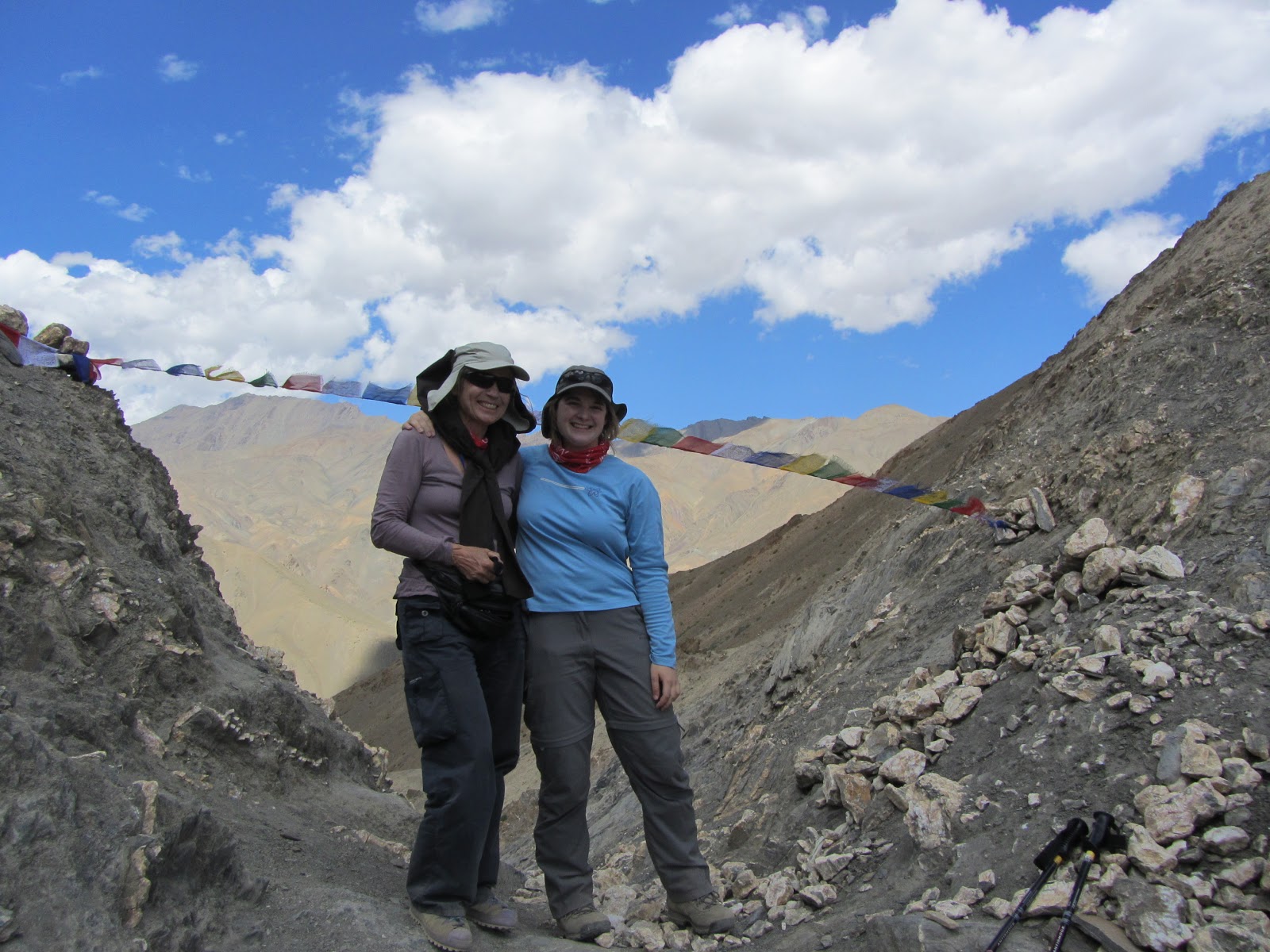
Annetraud and me at the Prinkiti-La

The walk down was not as bad as I had imagined it, because during the 550 meters, there were clouds and wind to make us feel less hot. We reached the cars after three hours and had lunch at a nice river which we crossed without our shoes on to enjoy the shade on the other side. We got luch boxes from the hotel which included toast, an egg, an apple, mango juice, a potato, a Milk Treat, cookies and one slice of cheese.
When we had finished, we picked up the two others, who were waiting in the next village, and drove all the way back and further to Tingmosgang. Here we had some tea before we got our rooms which are very comfortable. Maybe that’s because this village is called the richest in Ladakh.

In the afternoon we had spare time which I used to upload my pictures and to get some rest. Also, Annetraud and I did some yoga which was quite funny.
Dinner was not as good as in Alchi but that’s really hard to reach up to. We had buffet again and apricots as dessert.
Now the flies are really annoying me. They got in in the afternoon and now they are sssrrrring around and tickling my arms. Why is there a cow right in front of our window?
How many flies can you find on our room's ceiling?

Tuesday, September 6, 2011

Mangyu and Tsatsapuri temple near Alchi

In our hotel in Alchi, breakfast was better than in Leh. We had muesli and fruit, toast, apricot jam and egg omelets. Then we got into the jeeps again to drive to Mangyu, another monastery that is located in a valley that didn’t have any road leading to it until 14 years ago and where there is a bus that drives there once a week.
For our tour today, a professor from Austria who has been working in Ladakh as an architect, joined us and explained some things as well. In Mangyu we also met a young woman who was in charge of the renovation works that were currently being done. She explained that the most important thing of a monastery like the one here or any other building with paintings was the roof. If the roof leaks, the paintings get destroyed. She showed us some wooden parts which they had replaced and we saw people working in the temple.

Two were just making a new courtyard which would allow the water to flow down instead of into the temple.Inside we weren’t allowed to take any pictures because the paintings are very fragile.
We walked down the road we had come up with the jeeps. On our way we were fascinated by all the different rocks and mountain forms.
For lunch we had Italian and American food: really good french fries, maccaroni, spaghetti and vegetables. And after a short rest we had tea and then walked up the hill to see Tsatsapuri, a temple that is somehow a secret tip. It is a private building and therefore we were allowed to take as many pictures as we wanted. We saw many beautiful paintings and some rare mandalas. One was not symmetrical but had five smaller mandalas in the middle which represented the five forms of the Buddha. Another mandala had eight entrances instead of the typical four.
A very rare mandala
On our way down we met some sheep and cows that were running around freely.

Now lunch and tomorrow we ware getting up early to avoid the midday sun when hiking.

Monday, September 5, 2011

Likir monastery and Alchi

Earlier than in the past days we had breakfast. We packed our things together and our drivers put them into and onto the jeeps. Then we left Leh to drive west. For a long time we passed by military areas. There are 30 000 soldiers in Ladakh to defend the country against Pakistan and China who both occupied parts of the land. Our guide said that there is going on some kind of cold war between China and India because of that. To understand why China claims Ladakh, one must know that Ladakh agreed to accept the Dalai Lama as its religious leader. When China invaded Tibet, it thought that Ladakh also belonged to Tibet and therefore now to China.
While we drove, we sometimes passed diversions that leaded around parts of the street that were washed away with the flood last year. Now there are street workers (very often women, sometimes they even bring their kids) who build it up again.
One photo point we had was the joining of the Indus and Zanskar river. The latter freezes completely over in winter and people use it as a road to Leh.

The first monastery we visited was Likir. It is famous for its huge sitting Buddha statue. It was a pity that it is renovated at the moment and we couldn’t see its full beauty. In the courtyard of the monastery there were some of the oldest prayer wheels in Ladakh. They are still in use today (I turned them too :-) ). Inside the assembly hall, there was a seat reserved for the brother of the Dalai Lama who had been the leader of this monastery and some others. But after some time he decided to give up his life as a monk and lives a “normal life” since. He is working for his brother actually. The funny thing is that on his seat there is a picture of him as a boy because today he is not wearing the monk robe anymore.
Another explanation we got was about the wheel with deers on each side. The wheel symbolizes the whole Buddhist teaching while the deer remind the viewer of Buddha’s first teaching which he gave in a deer park.

We left the monastery and after some minutes of driving, we were left by the drivers and went on by foot. We walked down a dry valley which looked like an American canyon. It was very hot and there was hardly any shade to cool down. It took us approximately two hours to reach Saspol, a quite large village. There we met some children who just did the washing up. This was the liveliest village we saw so far.
The road to Alchi had some very bad parts but we eventually reached our destination. We had a really, really good lunch at the hotel and got our rooms that are more clean and nicer than those in Leh. But power seems to fail from time to time because we got a candle and matches too!
After a short rest, we met again to visit Alchi’s monastery. There are only four monks living here because when Likir was built, most moved there. But in this monastery there are some real treasures. There are statues of seven meters height and thousand year old paintings that cover all walls. One building resembles a 3D-mandala. Unfortunately, you aren’t allowed to take any pictures inside, so I can’t share this amazing place with you. The photograph I took is from the inside of a stupa that also has the mandala style.
We again learned loads about Buddhism and I find it very complicated to differ between all those gods, buddhas, bodhisattvas, arias and siddhas. And the problem is that the same person can be painted in over 20 ways!

So now we’re looking forward to some more excellent food for dinner and then I’ll write some post cards. Finally. :)

Sunday, September 4, 2011

Mask Dance and Hemis Monastery


Have you ever seen a real Buddhist Mask Dance? I guess you haven’t because they are practiced very rarely and even more seldom for tourists. We were among the lucky ones to be part of the Chhams/Mask Dance that took place during the Ladakh Festival. We left the hotel at 10am to get sitting places in the courtyard of the Ladakh Buddhist Association.

The Tung players
Before the real event started, there were Tung players (Tung is a horn similar to the alphorn) who called everyone to come. A woman told the audience in English that the monks that were going to perform the dance came from another monastery and that the Festival was very thankful that they had agreed join the event.
The program included several different dance sequences. Unfortunately, I didn’t understand much of their meaning although our guide did his best to explain. There was one dance where four masked monks represented the protection gods which you can find at the entry of every monastery. Another dancer cut something, I think it was tsampa, to symbolize the destroying of bad energy.

An interesting fact for everyone who likes to clap their hands: It is not common to applaud after Buddhist performances. Although the speaker said that after the first applause, some people didn’t get it and clapped their hands every time...
I filmed some parts of the dance, maybe I can upload it.
In our lunch break we went to a restaurant called Penguin where I had my first Momos. Momo is a traditional Tibetan dish that is similar to German Teigtaschen or Austrian Schlutzkrapfen or Kärntner Kasnudeln. It was really good.
From the office of our travel agency, we started our jeep journey to Hemis. It was quite a long drive and I got really hot because the sun was beaming right through the window. We passed some villages and monasteries which we will visit later.

Hemis is known as the richest monastery in Ladakh. This is because it was built hidden in a valley and therefore has never been found by invaders. In addition, lots of land belongs to Hemis and the farmers who grow crops there give a part of their harvest back to the monastery.
The monks in Hemis belong to the Red Head School, which is one of the most popular schools in Buddhism.
Our guide explained a lot about the philosophy of Buddhism and I tried to keep as much as possible by taking notes but still it is difficult to understand. I’ll tell you some of the things he told us about the wheel of life. This painting can be found at the entrance to every prayer hall. Maybe you have seen it before.
The wheel of life in Hemis
The parts of the wheel represent the following (starting from above, going clockwise): the world of gods, the world of humans, the ghost world, hell, the animal world and the world of demigods. The upper three are the happy part while the lower three stand for suffering and problems.
In the middle you can see a snake, a hen and a pig. Those are symbols for the three poisons: the snake is anger, hatred and ill-will, the pig is desire, and the pig ignorance and delusion. If one overcomes those poisons, they can be enlightened and go to paradise which is called nirvana.

We had a look at the statues in the prayer room and at the most famous statue of Hemis: the Guru Rinpoche or Padmasambhava. He was a Lama who was invited to bring Buddhism to Tibet and who is said to have had supernatural powers.
After visiting the museum of Hemis where they show some of their valuable objects like old statues, paintings or prayer rolls, we walked down the valley and were picked up by the jeeps again. Before we left, some of us had a small snack. I wanted to offer a snack to another group member when an old man came over and wanted one too. I would have given him one of the two in my hand but he just took both and left! Never mind, I had a third one and he was quite happy with his. :)

The trip back was interesting because our guide explained a bit as we passed by some sights. For example we drove past the Dalai Lama’s residence in Ladakh.

So tomorrow we are leaving Leh and I guess that I won’t have any Internet connection until we come back in four days.

4. September 2011

Saturday, September 3, 2011

First full day in Leh


Today was our first program day. After having a hot shower (it was hard to go out to the cold again!) and breakfast (toast, egg omelet and strawberry jam) in the morning, we went to town. Our first point of interest was the Buddhist center where we had a look at the prayer room and at a thanka exhibition that was set up for the Ladakh festival.
We went on through the small streets of Leh and came to a ladakhi bakery. They put the dough onto the walls of their oven and the result is delicious. We saw the oldest tree of Ladakh and the main market of old Leh.
A café was our next stop and after enjoying a nice view over Leh, we went to the same restaurant as we were yesterday to have lunch.
At 3pm we met again. Two cars brought us to Tsemo, a hill above Leh. There we visited Gonkhang and Chamba-Lhathang, a monastery and a shrine. Our guide explained to us what the paintings on the walls meant and that the big statue represents the Buddha of the future who is going to come when the Buddhist knowledge is fading out. That will be in about 2500 years.
We walked down the hill and were picked up again by the two jeeps. The next visiting point was a monastery called Sankar. It was rather big in comparison to the other one and had lots of beautiful statues. Again, we learned a lot about the meaning of the statues and paintings. I’ll add the stories to the pictures when I have more time.
We got into the cars another time and our way led us uphill to the Shanti-Stupa which was newly built and is just huge. From the hill it is located at, we also had a very nice view to Leh and its surroundings. We could also see the big military base from above. Our guide told us that they are about 30 000 soldiers in Ladakh because of the Chinese border. Every family has at least one member who is or was in the army!
Me in front of the Shanti-Stupa in Leh
Dinner was good today, we had rice, beans, tofu, chicken and bread. After eating, Annetraud and I walked up to one of the Cybercafes and now I am using the WiFi they're having. I uploaded all the blogs I wrote in the past days and now I'll have a look whether I can add some pictures too. It is so beautiful here, you have to see it! :)

Friday, September 2, 2011

Finally in Leh

Finally, our flight was called out and we were led into the airplane. I expected it to be very small but it was actually bigger than the one we had from Innsbruck to Frankfurt. The travel agency had booked seats on the left side only to guarantee us a great view. The sun started to rise at 5.30 am and when we took off, I could see Delhi from above.
We had breakfast on board which was good but included a lemon juice that was just awful. I can’t imagine that anybody could ever drink it!
I nearly fell asleep because I was really tired but the Himalayas woke me up again. At first there were just single mountain tops that rose out of the cloud ocean like small islands. Then the islands got bigger and we were right above the highest mountain rage on earth. Most summits were covered with snow and there were many glaciers. But in contrast to the alps, the lower altitudes were just brown or gray and there was no green at all. The rising sun painted long shadows between the mountains and many valleys looked as if they were huge lakes. But in reality it is all very dry and no sign of human influence could be seen until we reached the Indus valley where Leh is also located. Suddenly, green fields appeared in between the dusty mountain rages and the river Indus formed an oasis in the middle of a desert that is located on top of the world.
The landing was quite spectacular: the pilot made two turns before he came down to the airport. In the small welcome hall, we got our luggage back, filled out another sheet for foreigners and got a program for the Ladakh Festival that started today.
Two guides picked us up and drove us to our hotel. I sat in front – on the left side. It is really strange to drive through an unknown country with lots of new impressions and all of that on the wrong side of the street! To my surprise, there were really cows on the streets. I didn’t expect that because I thought that it was a stereotype that in India there are cows everywhere. I also noticed many stray dogs and lots of garbage at the sides of the street.
We arrived at the hotel, got a short briefing about the trip and had another breakfast. It was about 8am ladakhi time and I noticed that I was very tired. I had been awake for almost 24 hours! When we got our rooms, I didn’t care much about anything but the bed. Although I must have had a higher pulse and although I heard that you usually sleep bad in high altitude, I slept well until we had a very good lunch at 1 o’clock. After that we had free time and Annetraud and I decided to have a walk in town. It was hot and we did notice the 3,500 meters after all. We went slowly and finally had a mango juice in a small Café. As soon as we were back, I took another nap. I’m very lucky to be able to sleep without problems.
me at a prayer mill near our hotel
At 6pm, five of the seven group members left to have dinner. Before that we took another stroll to Leh and this time I found it easier to walk. We saw loads of open shops, restaurants and Internet Cafés, most of them had already put on their diesel generator. The official power system doesn’t seem to work very well. The Tibetan restaurant we had dinner at also had a generator which broke down several times. But nobody minds, that’s Leh.
Before going back, I went into a Internet Café to give a short update on my blog. I want everyone to know that we arrived savely. I payed 10 rupees for about 10 minutes which is close to nothing.
On the way back, I was happy that we had one headlamp – none of the streetlamps was working...
2. September 2011

Arrival in India

Just a short notice that we arrived safely. After I was nearly 24 hours awake, I could finally fall into my bed in Leh. Everything is great here, the hotel is clean and calm, our guide is very nice and the city is interesting too. What I don't like is the rubbish that is lying everywhere on the street and that is eaten by the cows and dogs that are running free here.

More update tomorrow, I'll bring my laptop then and upload the text I've already written during the voyage.

The Journey continues to Delhi


2:37
We finally arrived in Delhi. Our plane was much bigger than the first one. The seats we had were separated but the person who would have sat between us didn’t come and finally we had three seats for the two of us. We left with a 40 minute delay of which we could only make up 30 minutes until we arrived in India. We had two meals on board, dinner was something Indian which tasted quite good (except for some strange mango thing which neither of us finished) and around 11pm we got another snack that was something like dürüm. I slept a bit and listened to the radio. They showed Pirates of The Caribbean On Stranger Tides on the screen but I gave up concentrating on Johnny Depp’s voice and had another nap. Later on I watched an Indian film which was supposed to be funny but actually wasn’t (according to me). It had subtitles and the main character spoke a mix of Hindi and English. I sometimes couldn’t tell which language she was talking in at the moment.
When we landed in Delhi, we had just come out of a thunderstorm we were told that it was 32°C outside which sounded quite ridiculous because in the airplane it was really cold. Luckily we were directly led into the airport and didn’t taste any Indian air at first.
We were standing in the queue for the passport checks when an Indian asked me for my pen. He asked in German, which surprised me and when we came to talk a bit, we found out that he studies German and just came back from a trip to Germany.
It took ages until we had our luggage back and it took even longer to change money because we had to count it again and again. Which was a good thing because they would have given us 500 rupees less. After another two checkpoints we reached the exit and were welcomed by a WeltWeitWandern sign. The rest of the group was already there, except for one woman who had gone to the doctor because of her eyes. Hopefully she’ll be able to follow us tomorrow.
Our guide showed us the way to the national flight hall, gave us our tickets and a tent and left us. We’ll meet him again when we come back to Delhi. We shortly went outside the hall and were overwhelmed by 32°C and a very high humidity. Everyone was happy to get back to the cold airport hall.
we didn't check whether the walking time was right
Now we’re resting in the hall and waiting for our flights to Leh (there are two flights at the same time and we were separated because this way everyone can have a window seat on the left hand side). We will be leaving at 5:45 am lots of time until then!

4:45 am
The airport WiFi doesn’t work what is kind of annoying. It should send a text message with a user name and password to your mobile phone but I don’t get that text... At least there is a charging station here next to the gate.
It is really strange to go to a duty free shop in Delhi and find products as Toblerone, Rittersport and Swarovski. I expected McDonalds but not Toblerone! Hopefully we won’t meet so many European brands in Ladakh. If I am in Asia, I don’t want to buy German chocolate!

Thursday, September 1, 2011

Travel to Frankfurt


Today is the big day. I woke up at quarter to six in the morning, some minutes before my alarm clock rang. I used the time I had until the flight to book my university courses and to update them into my calendar.
For breakfast, my dad went to the bakery to get fresh bread and it tasted wonderful, maybe because I know that I won’t eat exactly that bread for three weeks...
I didn’t feel nervous but I guess that I was. I weighed my luggage several times and was quite satisfied that it was not too heavy but had 16 kilos of 20 allowed. My hand luggage was 7 kilos and also rather light. At the airport we waited for Annetraud and it was a strange feeling to be still there but to have already started the trip. When Annetraud arrived, we checked in and had a big farewell before we went through the security checks. Unfortunately I had forgotten to take the sunscreen out of my backpack and I had to give it to my family who had luckily waited until we passed the security check. Then we were in.
The plane was the smallest I ever flew with, just four seats in a row. The flight was definitely not overbooked – there were lots of free seats and about 25 guests in total. It was amazing to fly over the mountains and we left Tyrol behind. After one hour we had a nice landing in Frankfurt. There we did a small hike to the right gate and now we are having lunch in a small Asian restaurant.
Can you find our flight? ;)

Wednesday, August 31, 2011

Hiking Tour Glungezer Hütte

Like planned, my aunt, Mario and I did a two day training hike to the Glungezer Hütte near Tulfes in Tyrol. My uncle was as kind as to bring us to the station of the Patscherkofelbahn cablecar which took us to the Patscherkofel, Innsbruck's home mountain. There were hardly any people in the cablecar and also when we started walking we met less and less other hikers. At first the path called Zirbenweg, was rather flat - we didn't gain or lose any hight. Then it slowly got steeper. At a parting of the ways, we seperated and while my aunt stayed on the original path, Mario and I went up to the Viggarspitze which is 2306 meters high. We enjoyed the beautiful sight before going down again and following the first path as well.


After four hours we finally arrived at the hut, which appeared quite suddenly after a quite steep slope. The altitude of 2610 meters is perfect for acclimatising. We were welcomed by my aunt who had already ordered tea. The host of the hut described to us how to get to our room, which was rather unnecessary because there were only two rooms in the hut! Ours was small and cold (the window was open) but nice. There were four places to sleep so we could use one as deposit station.
Next, we had dinner. If anybody ever told you that on mountain huts you just get simple or bad food, don't believe it because it is not true. We had four courses, four very good courses! Starter, soup, main course and desert. The hosts can really cook well!


We were all tired and went to bed early, around 9 o'clock. Unfortunately we didn't sleep too well and when the alarm clock rang at 6 am, nobody wanted to get up and leave their warm bed. But we had decided to watch the sunrise, so we had to face the cold air outside. It was 4°C and windy when we had a first glance towards east. The sun didn't show yet so we quickly went inside again and I took another jacket. This was when my aunt and I decided that we had to take along more warm clothes than we originally wanted to.
The sunrise itself was really beautiful. Have a look at the pictures, it is around half as lovely as it was in reality.


At breakfast we were the last ones because all other guest had already left. We took our time and after packing our things together, having a chat with the host (and explaining the Pangaea project to him), we also headed off. Our fist goal was the Glungezer - it was just 15 minutes from the hut and that's how we made another summit, this one is 2677 meters high.
Then we started our long way down. We met sheep along the way and saw several marmots that didn't care about us standing close by and taking pictures. They were rather fat too, ready for winter I guess. I never before got so close to a marmot.
Our hike ended at the upper station of the Glungezerbahn. It took us about one hour to get down to Tulfes because the lifts are quite slow. But we had time to enjoy the view and reflect on the nice tour we did.
In Tulfes we were picked up by my uncle again (after some difficulties) and we finally were back in civilisation.


I spent the rest of the day with packing, weighing my luggage and having my hair cut (it's short... :-) ). Everything is ready, now I need to focus on what's lying ahead of me and try not to panic. :-D

Glungezerhütte